Cross Section Properties Calculator Software
This page lists the cross section properties calculated by ShapeDesigner SaaS software. These calculated section properties are grouped by categories in the tables below.
General Section Properties
| Section Property | Description |
|---|---|
| Area | Total area |
| Transf.Area | Transformed composite area |
| Mass/L | Total mass per unit length |
| Xc, Yc | Centroid X and Y position |
| NA(Deg) | Elastic neutral axis angle |
| PNA(x,y) | Plastic neutral axis position |
| Bx, By | X and Y stability constants |
Torsion and Warping Section Properties
| Section Property | Description |
|---|---|
| J(Torsion) | Torsion constant |
| Cw(Warping) | Warping constant |
| Xs, Ys | X and Y position of shear center |
| Kx, Ky | Shear section constant about X and Y axes |
| Ax, Ay | Shear reduced areas about X and Y axes |
| Ios | Moment of inertia about shear center |
| ros | Radius of gyration about shear center |
| Swx, Swy | Sectorial product of area with respect to X and Y axes |
| Dsc | Distance between shear center and centroid |
| B torsional-flexural constant | Torsional-flexural constant |
Composite section Properties
| Section Property | Description |
|---|---|
| Material name | Elastic modulus of the reference material |
| Xcc, Ycc | X and Y centroid position in transformed composite section |
Stress Section Properties
| Section Property | Description |
|---|---|
| Sig-yield T | Tensile stress yield |
| Sig-yield C | Compressive stress yield |
| Tau yield | Shear stress yield tau |
| Sig-x max T | Maximum tensile stress |
| Sig-x max C | Maximum compressive stress |
| Fpt | Maximum tensile force related to plastic stress block |
| Fpc | Maximum compressive force related to plastic stress block |
| Np Column Capacity | Axial capacity for column |
Loads Properties
| Section Property | Description |
|---|---|
| Moment Mx, My | Applied moment about X and Y axes |
| Axial N | Applied axial load |
| Torque Tz | Applied torque load |
| Bimoment Bw | Applied bi-moment load |
| Shear Vx, Vy | Applied shear load in Y and Y direction |
X-Y Axes Section Properties
| Section Property | Description |
|---|---|
| Ix, Iy | Moment of inertia about X and Y axes |
| Ixy | Product of inertia about X-Y axes origin |
| Io | Polar moment of inertia about origin |
| rx, ry | Radius of gyration about X and Y axes |
| ro | Radius of gyration about X-Y axes origin |
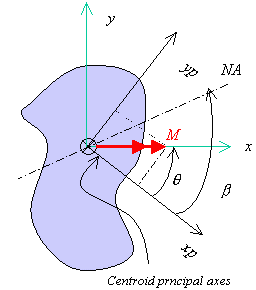
Centroidal Axes Section Properties
Principal Axes Section Properties
Elastic Neutral Axis Section Properties
Maximum stresses
- sx: Axial stress
- sw: Axial warping stress
- tsx, tsy: Shear stress in x and y directions
- txz, tyz: Torsional shear stress in x and y directions
Minimum stresses
- sx: Axial stress
- sw: Axial warping stress
- tsx, tsy: Shear stress in x and y directions
- txz, tyz: Torsional shear stress in x and y directions
Stresses at custom position
- sx: Axial stress
- sw: Axial warping stress
- tsx, tsy: Shear stress in x and y directions
- txz, tyz: Torsional shear stress in x and y directions
- qx, qy: Flow stress in x and y directions
- sI: sII ; sIII: Principal stresses
Failure criteria for yield strength
- Maximum normal stress criterion
- Tresca criterion
- Von Mises-Hencky criterion
- Saint-Venant criterion
- Maximum strain energy criterion
ShapeDesigner SaaS Product Page
Return to the ShapeDesigner SaaS product page.
Real Time Section Property Display
ShapeDesigner displays all geometric section properties in real time in the CAD at design time. This means, for example, that you can move a point and see how the section properties such as area or inertia evolve as the movement is occurring.
Real Torsion and Warping Constants
Contrary to most software available, ShapeDesigner makes no assumptions or restrictions on the calculation of shear and torsion section properties. ShapeDesigner uses an advanced and efficient finite element approach to calculate these constants. The complexity of the finite element approach is hidden from the user. There is no general method for computing shear and torsion section properties without using this finite element approach.
Download ShapeDesigner SaaS
To download ShapeDesigner, simply create and account and use the download link from your account. Download ShapeDesigner SaaS.